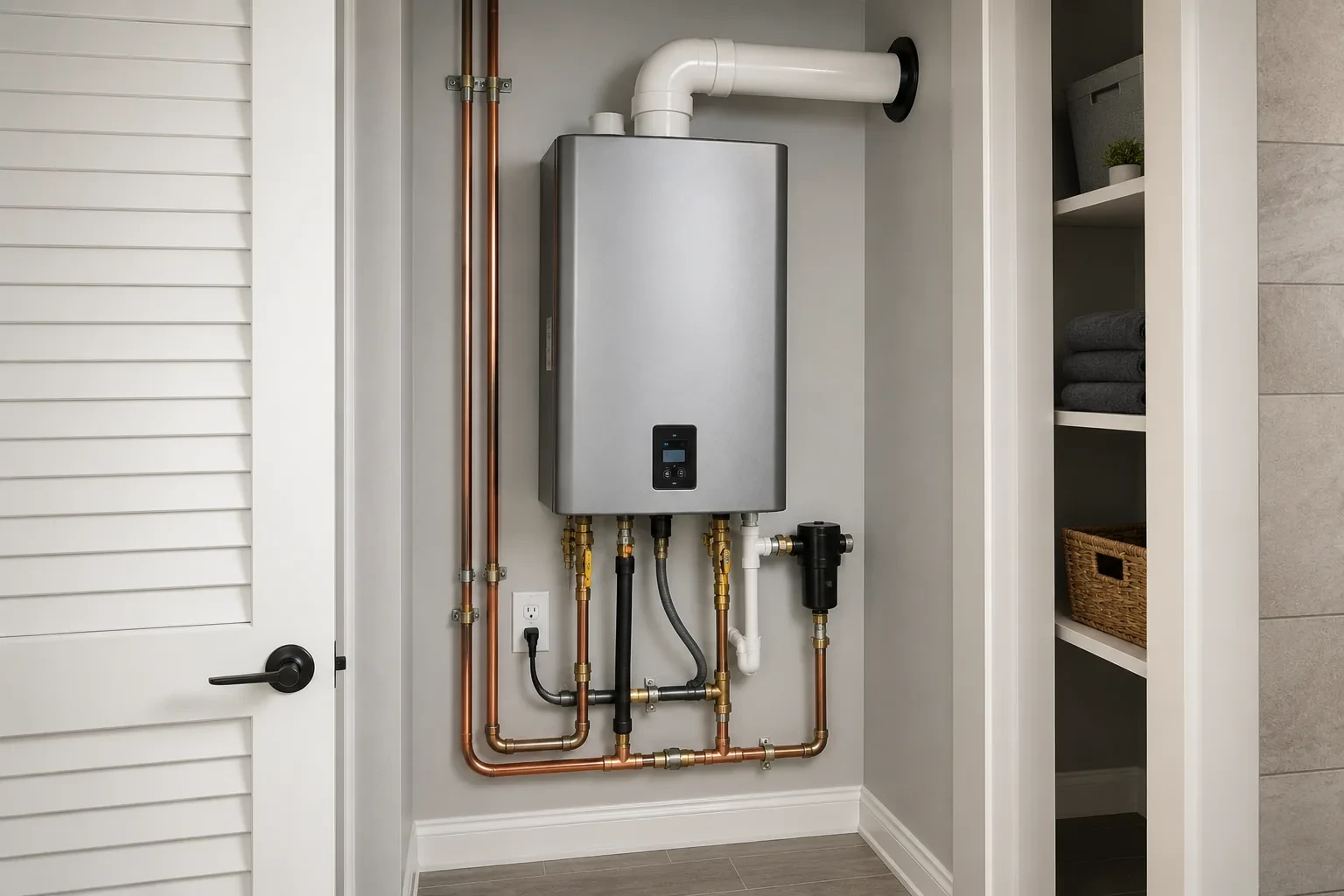
Tank vs. Tankless Water Heaters: Which Suits Your Home?
5 min read
Short answer
A standard tank costs less up front and is simpler to fit, which makes it the right answer for most like-for-like replacements. A tankless unit costs more to install but delivers continuous hot water, takes far less space, and typically lasts 15 to 20 years against a tank's 8 to 12 — so it tends to win over a long enough horizon. The deciding constraint is usually practical rather than financial: tankless needs adequate gas supply and correct venting, and not every home has both.
There is no universally correct answer here, and anyone who gives you one without looking at your gas line is selling rather than advising. Here is how the two actually compare.
The Honest Comparison
Where each option genuinely wins:
- Up-front cost — tank wins, often substantially
- Running cost and efficiency — tankless wins, since it heats only on demand
- Lifespan — tankless wins, roughly 15 to 20 years against 8 to 12
- Space — tankless wins, it mounts on a wall instead of occupying floor area
- Simplicity of installation — tank wins, especially as a like-for-like swap
- Continuous supply — tankless wins, you do not run out mid-shower
The Constraint Most People Miss
A tankless unit heats water instantly, which means it draws considerably more gas at peak than a tank does. If your existing gas line cannot supply that rate, it has to be upgraded — and that cost belongs in the comparison from the start, not discovered halfway through the job.
Venting is the second constraint. Tankless units vent differently from tank units, and retrofitting that into an existing closet or utility space is sometimes straightforward and sometimes not.
We check both before quoting. If your setup cannot take tankless without disproportionate work, we will say so rather than quoting the upgrade and letting you find out later.
Maintenance Is Not Optional on Tankless
Tankless units need periodic descaling, and the mineral content in North Fulton's supply makes that more relevant here than in soft-water regions.
Skipped descaling is the main reason a tankless unit fails early and forfeits its lifespan advantage. If you are not going to keep up with it, the long-run maths shifts back toward a tank.
When a Tank Is Simply the Right Answer
If your current setup works, the unit has reached the end of its life, and you are not short of space, a like-for-like tank swap is usually the sensible choice. It is finished in a few hours and costs least.
Tankless makes most sense when you are already reworking the space, when you genuinely run out of hot water with the current unit, or when you intend to stay in the house long enough for the efficiency and lifespan to pay back the install premium.
Frequently Asked Questions
- Do I need a permit to switch to tankless in Georgia?
- Water heater replacement generally requires a permit in Georgia, and switching type does not change that. The licensed plumber doing the work should pull it.
- How long does a tankless installation take?
- Longer than a tank swap. A like-for-like tank replacement is often a few hours; a first-time tankless fit involves venting and gas work and typically takes longer.
- Will tankless really save money?
- On running cost, yes, because it heats only on demand. Whether it saves overall depends on how long you stay in the property and whether a gas line upgrade is needed up front.